Locating IFSC & MICR on Your Cheque
A quick visual guide to help you find these important codes on a standard Indian bank cheque.
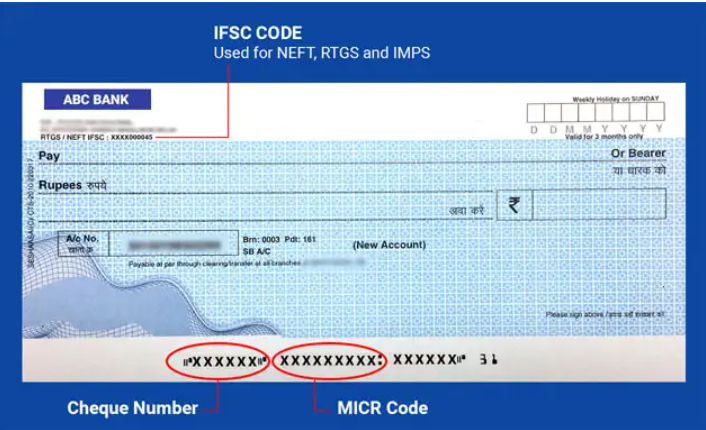
Note: The IFSC and MICR placement may slightly vary between banks, but is common across most cheques.
Get instant IFSC code directly on Telegram – Free & Easy to Use
🚀 Open Telegram BotEmbed our fast, mobile-friendly IFSC Lookup widget on your blog or website. No API key. No cost. Just copy-paste and use!
The IFSC Finder by PMetroMart is a fast, accurate, and easy-to-use tool designed to help you locate the IFSC and MICR codes of any Indian bank branch. Whether you're sending money via NEFT, RTGS, or IMPS, having the correct IFSC code is crucial for smooth transactions.
With PMetroMart’s IFSC Finder, you can search using the bank name, state, district, or branch, and instantly get verified information. The database covers all leading Indian banks such as State Bank of India (SBI), HDFC Bank, ICICI Bank, Axis Bank, and Punjab National Bank. All details are regularly updated from trusted banking sources for accuracy.
Built with simplicity and precision, the PMetroMart IFSC Finder ensures a hassle-free experience for users looking for bank branch details online. It’s your one-stop solution to find IFSC codes in seconds.
Click below to get your special Reward !
| Branch | IFSC | Bank | City | State |
|---|---|---|---|---|
| ⌨ Start typing to search... | ||||
The IFSC code (Indian Financial System Code) is an 11-character unique identifier assigned by the Reserve Bank of India (RBI) to every bank branch in India participating in electronic payment systems like NEFT, RTGS, and IMPS. It ensures safe and accurate fund transfers across banks. The IFSC structure includes four letters representing the bank, followed by a zero, and then six digits denoting the branch. For example, SBIN0000456 represents State Bank of India, branch 0456. Popular banks such as India Post Payments Bank (IPPB), Airtel Payments Bank, Jio Payments Bank, and Gramin Banks also use IFSC code for online transfers and UPI transactions. You can easily search IFSC code using our IFSC Finder tool.
The easiest way to find your bank IFSC code is through an online IFSC Finder like pmetromart.in. Enter your bank name (e.g., IPPB, Airtel Payments Bank, Jio Bank, or any Gramin Bank), along with state or branch details to get the IFSC, MICR, and address instantly. You can also find it on your cheque leaf, passbook, or net banking portal. Whether you transfer money via NEFT, RTGS, IMPS, or UPI, using the correct IFSC code ensures secure and timely fund transfer.
The IFSC Code is vital in digital banking. It enables faster and more secure interbank transfers, reducing human error. All major Indian banks — including IPPB, Airtel Payments Bank, Jio Payments Bank, and regional Gramin Banks — rely on IFSC for processing online payments. It helps in easy account linking for UPI, NEFT, and IMPS transactions, empowering customers across urban and rural India to make smooth digital payments.
An IFSC code has 11 characters — four letters for the bank, a zero, and six digits for the branch. Example: HDFC0001234. Here, “HDFC” is the bank and “001234” is the branch. This standard structure helps identify branches of all banks including IPPB, Airtel Payments Bank, and Jio Payments Bank with ease. You can verify or search these codes on PMETROMART.
The MICR (Magnetic Ink Character Recognition) code is a 9-digit number printed on cheques. It helps in automated cheque clearing by identifying bank and branch details. IFSC is for digital transfers, while MICR supports cheque-based payments. Both work together to streamline India’s banking system.
IFSC is for domestic transfers (NEFT/RTGS/IMPS), MICR for cheque clearance, and SWIFT for international transactions. Together, they ensure accuracy and transparency in financial operations.
| Parameter | IFSC Code | MICR Code | SWIFT Code |
|---|---|---|---|
| Purpose | Online fund transfers (NEFT, RTGS, IMPS) | Cheque processing and clearance | International money transfers |
| Format | 11 alphanumeric characters | 9 digits | 8 or 11 alphanumeric characters |
| Example | SBIN0000456 | 400002056 | SBININBBXXX |
| Issued By | Reserve Bank of India | Reserve Bank of India | SWIFT Organization |
The CIF number or Customer Information File number uniquely identifies each customer’s banking profile. It includes account, KYC, and transaction details. While IFSC identifies a branch, the CIF identifies the customer — helping banks like IPPB and Gramin Banks offer personalized digital services.
🔎 Use our IFSC Finder to search verified IFSC, MICR, and SWIFT codes for IPPB, Airtel Payments Bank, Jio Payments Bank, and Gramin Banks across India.
A quick visual guide to help you find these important codes on a standard Indian bank cheque.
Note: The IFSC and MICR placement may slightly vary between banks, but is common across most cheques.
People often ask how to find IFSC code of their bank branches easily. Below are some of the most common questions answered using our IFSC Finder tool.
